Skip to content

Maximum Communications Gap

In this example we'll analyze the communication gaps between a satellite constellation and supporting ground station network. For this work we'll use the Umbra constellation and 5 KSAT ground stations (Svalbard, Punta Arenas, Hartebeesthoek, Awarua, and Athens).

The maximum contact gap is a significant factor in the reactivity (speed from request to uplink) and latency (time from collection to delivery) for satellite imaging constellations.


Setup

First, we'll import the necessary libraries, initialize Earth orientation parameters, download the latest TLE data for all active spacecraft, and filter to select just the Umbra satellites:

import time
import csv
import os
import pathlib
import sys
import brahe as bh
import numpy as np
import plotly.graph_objects as go
import matplotlib.pyplot as plt
import cartopy.crs as ccrs

bh.initialize_eop()

We download all active satellite TLEs from CelesTrak as propagators and filter for satellites with "UMBRA" in their name:

1
2
3
4
all_active_props = bh.datasets.celestrak.get_tles_as_propagators("active", 60.0)

# Filter for Umbra satellites (name contains "UMBRA")
umbra_props = [prop for prop in all_active_props if "UMBRA" in prop.get_name().upper()]

Next, we load the 5 specific KSAT ground stations that will support communications:

1
2
3
4
5
all_ksat = bh.datasets.groundstations.load("ksat")

# Filter for the 5 specific stations mentioned in the problem
station_names = ["Svalbard", "Punta Arenas", "Hartebeesthoek", "Awarua", "Athens"]
ksat_stations = [s for s in all_ksat if s.get_name() in station_names]

Constellation Visualization

Before getting further into the analysis, it's useful to visualize the 3D geometry of the constellation. We propagate each satellite for one orbit and plot their trajectories:

for prop in umbra_props:
    orbital_period = bh.orbital_period(prop.semi_major_axis)
    prop.propagate_to(prop.epoch + orbital_period)

fig_3d = bh.plot_trajectory_3d(
    [
        {
            "trajectory": prop.trajectory,
            "mode": "markers",
            "size": 2,
            "label": prop.get_name(),
        }
        for prop in umbra_props
    ],
    units="km",
    show_earth=True,
    earth_texture="natural_earth_50m",
    backend="plotly",
    view_azimuth=45.0,
    view_elevation=30.0,
    view_distance=2.0,
)

The resulting plot shows the complete Umbra constellation orbiting Earth:

Access Computation

To figure out the contact gaps, we first need to compute all ground contacts over the 7-day propagation window. We reset the propagators and compute access windows with a 5° minimum elevation constraint:

# Reset all propagators
for prop in umbra_props:
    prop.reset()

# Define analysis period (7 days from first satellite's epoch)
epoch_start = umbra_props[0].epoch
epoch_end = epoch_start + 7 * 86400.0  # 7 days in seconds

# Propagate all satellites for 7 days
for prop in umbra_props:
    prop.propagate_to(epoch_end)

# Compute access windows with 5 degree minimum elevation
constraint = bh.ElevationConstraint(min_elevation_deg=5.0)
windows = bh.location_accesses(
    ksat_stations, umbra_props, epoch_start, epoch_end, constraint
)

Max Gap Computation

Next we'll compute the contact gaps over the course of the simulation. The contact gap is defined as the time between the last contact for a spacecraft and the next contact for that spacecraft. The gap is always computed on a per-spacecraft basis:

# Group windows by spacecraft
spacecraft_windows = {}
for window in windows:
    sat_name = window.satellite_name
    if sat_name not in spacecraft_windows:
        spacecraft_windows[sat_name] = []
    spacecraft_windows[sat_name].append(window)

# Sort each spacecraft's windows by start time
for sat_name in spacecraft_windows:
    spacecraft_windows[sat_name].sort(key=lambda w: w.start.jd())

# Compute gaps between consecutive contacts
gaps = []
for sat_name, sat_windows in spacecraft_windows.items():
    for i in range(len(sat_windows) - 1):
        gap_start = sat_windows[i].end
        gap_end = sat_windows[i + 1].start
        gap_duration = gap_end - gap_start  # Duration in seconds

        gaps.append(
            {
                "spacecraft": sat_name,
                "gap_start": gap_start,
                "gap_end": gap_end,
                "duration": gap_duration,
                "last_station": sat_windows[i].location_name,
                "next_station": sat_windows[i + 1].location_name,
            }
        )

# Sort gaps by duration (longest first)
gaps.sort(key=lambda g: g["duration"], reverse=True)

The 10 longest contact gaps are shown below:

Spacecraft Gap Start (UTC) Gap End (UTC) Duration Last Station Next Station
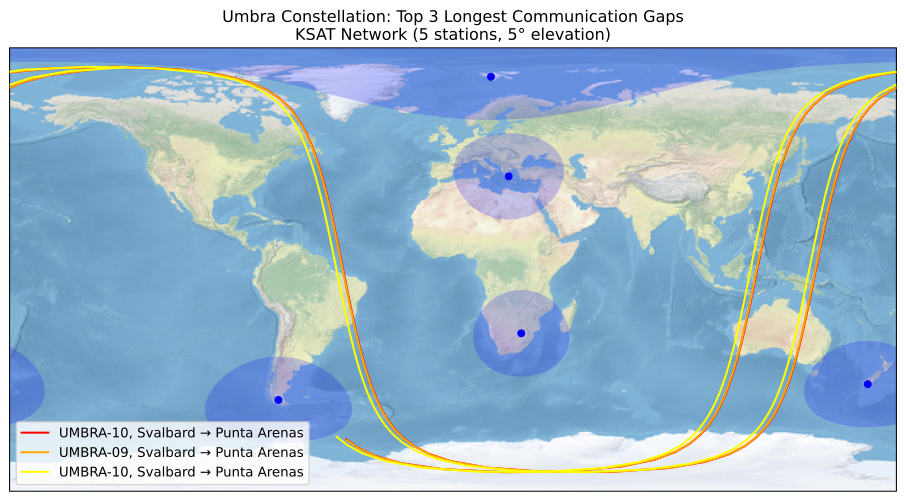
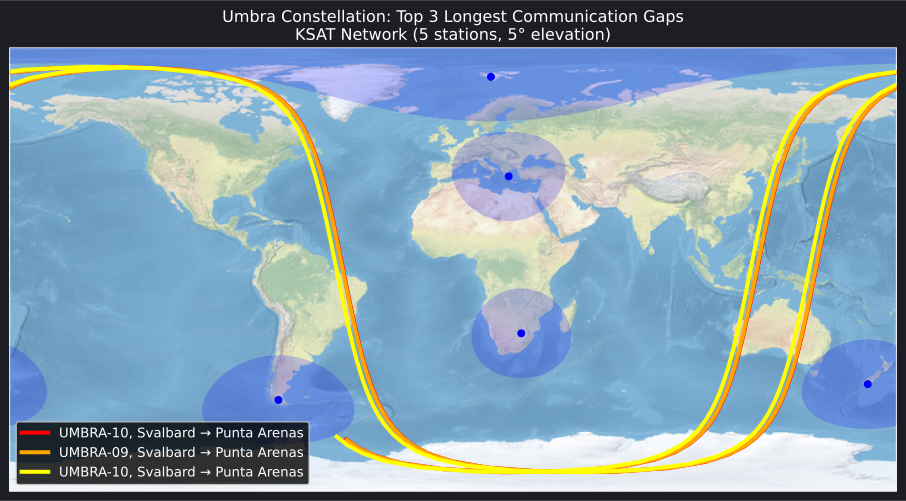
UMBRA-10 2026-01-06 00:49:11 2026-01-06 03:17:42 2h 28m 30s Svalbard Punta Arenas
UMBRA-09 2026-01-06 00:49:54 2026-01-06 03:18:24 2h 28m 29s Svalbard Punta Arenas
UMBRA-10 2026-01-05 00:59:48 2026-01-05 03:28:09 2h 28m 20s Svalbard Punta Arenas
UMBRA-09 2026-01-05 01:00:29 2026-01-05 03:28:49 2h 28m 19s Svalbard Punta Arenas
UMBRA-10 2026-01-04 01:10:21 2026-01-04 03:38:34 2h 28m 13s Svalbard Punta Arenas
UMBRA-09 2026-01-04 01:11:00 2026-01-04 03:39:13 2h 28m 12s Svalbard Punta Arenas
UMBRA-09 2026-01-07 00:39:16 2026-01-07 02:11:57 1h 32m 41s Svalbard Svalbard
UMBRA-10 2026-01-07 00:38:30 2026-01-07 02:11:10 1h 32m 40s Svalbard Svalbard
UMBRA-07 2026-01-03 23:14:57 2026-01-04 00:47:13 1h 32m 16s Svalbard Svalbard
UMBRA-10 2026-01-04 05:58:53 2026-01-04 07:31:02 1h 32m 9s Svalbard Svalbard

The distribution of gaps for the constellation is shown in this histogram:


To better understand what percentage of gaps fall below a certain duration, we create a cumulative distribution plot. This shows the percentage of gaps that are less than or equal to each duration value:

# Sort gap durations and compute cumulative percentages
sorted_gap_durations_hours = sorted(gap_durations_hours)
cumulative_percentages = [
    (i + 1) / len(sorted_gap_durations_hours) * 100
    for i in range(len(sorted_gap_durations_hours))
]

# Create cumulative distribution figure
fig_cumulative = go.Figure(
    data=[
        go.Scatter(
            x=sorted_gap_durations_hours,
            y=cumulative_percentages,
            mode="lines",
            line=dict(color="steelblue", width=2.5),
            hovertemplate="Gap Duration: %{x:.2f} hours<br>Cumulative: %{y:.1f}%<extra></extra>",
        )
    ]
)

# Add reference lines for key percentiles
percentile_values = {
    25: sorted_gap_durations_hours[int(len(sorted_gap_durations_hours) * 0.25)],
    50: sorted_gap_durations_hours[int(len(sorted_gap_durations_hours) * 0.50)],
    75: sorted_gap_durations_hours[int(len(sorted_gap_durations_hours) * 0.75)],
    90: sorted_gap_durations_hours[int(len(sorted_gap_durations_hours) * 0.90)],
}

shapes = []
annotations = []
for percentile, value in percentile_values.items():
    # Add horizontal line
    shapes.append(
        dict(
            type="line",
            x0=0,
            x1=value,
            y0=percentile,
            y1=percentile,
            line=dict(color="rgba(128, 128, 128, 0.3)", width=1, dash="dash"),
        )
    )
    # Add vertical line
    shapes.append(
        dict(
            type="line",
            x0=value,
            x1=value,
            y0=0,
            y1=percentile,
            line=dict(color="rgba(128, 128, 128, 0.3)", width=1, dash="dash"),
        )
    )
    # Add annotation
    annotations.append(
        dict(
            x=value,
            y=percentile,
            text=f"P{percentile}: {value:.2f}h",
            showarrow=False,
            xanchor="left",
            yanchor="bottom",
            xshift=5,
            yshift=5,
            font=dict(size=9, color="gray"),
        )
    )

fig_cumulative.update_layout(
    title="Umbra Constellation Cumulative Gap Distribution (7-day period)",
    xaxis_title="Gap Duration (hours)",
    yaxis_title="Cumulative Percentage (%)",
    height=700,
    margin=dict(l=60, r=40, t=80, b=60),
    shapes=shapes,
    annotations=annotations,
    yaxis=dict(range=[0, 105]),
)

The cumulative distribution plot includes reference lines at the 25th, 50th, 75th, and 90th percentiles, making it easy to determine what fraction of gaps are below a specific value.

Contact Gap Visualization

Finally, we'll visualize the 3 longest gaps on a ground track plot to see where they occur. For each gap, we extract the satellite's ground track during that time period and plot it as a colored segment. We also interpolate to the ±180° edges to avoid visual gaps at the antimeridian. This type of visualization can be helpful in understanding ground network design and where additional ground stations might help:

# Get the top 3 gaps
top_3_gaps = gaps[:3]
gap_colors = ["red", "orange", "yellow"]

# For each gap, we need to extract the ground track segment during that period
# We'll need to get the propagator for each gap's spacecraft
gap_segments_all = []

for gap_idx, gap in enumerate(top_3_gaps):
    # Create label with spacecraft name and station transition
    gap_label = f"{gap['spacecraft']}, {gap['last_station']}{gap['next_station']}"

    # Find the propagator for this gap's spacecraft
    sat_prop = None
    for prop in umbra_props:
        if prop.get_name() == gap["spacecraft"]:
            sat_prop = prop
            break

    if sat_prop is None:
        print(f"Warning: Could not find propagator for {gap['spacecraft']}")
        continue

    # Get states and epochs from the propagator's trajectory
    traj = sat_prop.trajectory
    states = traj.to_matrix()
    epochs = traj.epochs()

    # Extract ground track points during this gap period
    gap_lons = []
    gap_lats = []

    for i, ep in enumerate(epochs):
        if gap["gap_start"] <= ep <= gap["gap_end"]:
            # Convert to geodetic coordinates
            ecef_state = bh.state_eci_to_ecef(ep, states[i])
            lon, lat, alt = bh.position_ecef_to_geodetic(
                ecef_state[:3], bh.AngleFormat.RADIANS
            )
            gap_lons.append(np.degrees(lon))
            gap_lats.append(np.degrees(lat))

    # Split ground track at antimeridian crossings for proper plotting
    segments = bh.split_ground_track_at_antimeridian(gap_lons, gap_lats)

    # Interpolate segments to the edge at ±180° to avoid visual gaps
    # When a track crosses the antimeridian, add interpolated edge points
    interpolated_segments = []
    for seg_idx, (lon_seg, lat_seg) in enumerate(segments):
        lon_list = list(lon_seg)
        lat_list = list(lat_seg)

        # Check if this segment needs edge interpolation
        # If first point is not at edge but previous segment exists, interpolate start
        if seg_idx > 0 and len(lon_list) > 0:
            prev_lon, prev_lat = (
                segments[seg_idx - 1][0][-1],
                segments[seg_idx - 1][1][-1],
            )
            curr_lon, curr_lat = lon_list[0], lat_list[0]

            # Check if there was an antimeridian crossing
            if abs(curr_lon - prev_lon) > 180:
                # Determine which edge we're interpolating to
                if prev_lon > 0:  # Previous segment ends in positive lon
                    edge_lon = 180.0
                    # Linear interpolation to find latitude at 180°
                    t = (edge_lon - prev_lon) / ((curr_lon + 360) - prev_lon)
                    edge_lat = prev_lat + t * (curr_lat - prev_lat)
                    # Prepend edge point to current segment
                    lon_list.insert(0, edge_lon)
                    lat_list.insert(0, edge_lat)
                else:  # Previous segment ends in negative lon
                    edge_lon = -180.0
                    # Linear interpolation to find latitude at -180°
                    t = (edge_lon - prev_lon) / ((curr_lon - 360) - prev_lon)
                    edge_lat = prev_lat + t * (curr_lat - prev_lat)
                    # Prepend edge point to current segment
                    lon_list.insert(0, edge_lon)
                    lat_list.insert(0, edge_lat)

        # Check if segment should be extended to the edge at the end
        if seg_idx < len(segments) - 1 and len(lon_list) > 0:
            curr_lon, curr_lat = lon_list[-1], lat_list[-1]
            next_lon, next_lat = (
                segments[seg_idx + 1][0][0],
                segments[seg_idx + 1][1][0],
            )

            # Check if there will be an antimeridian crossing
            if abs(next_lon - curr_lon) > 180:
                # Determine which edge we're interpolating to
                if curr_lon > 0:  # Current segment ends in positive lon
                    edge_lon = 180.0
                    # Linear interpolation to find latitude at 180°
                    t = (edge_lon - curr_lon) / ((next_lon + 360) - curr_lon)
                    edge_lat = curr_lat + t * (next_lat - curr_lat)
                    # Append edge point to current segment
                    lon_list.append(edge_lon)
                    lat_list.append(edge_lat)
                else:  # Current segment ends in negative lon
                    edge_lon = -180.0
                    # Linear interpolation to find latitude at -180°
                    t = (edge_lon - curr_lon) / ((next_lon - 360) - curr_lon)
                    edge_lat = curr_lat + t * (next_lat - curr_lat)
                    # Append edge point to current segment
                    lon_list.append(edge_lon)
                    lat_list.append(edge_lat)

        interpolated_segments.append((lon_list, lat_list))

    gap_segments_all.append(
        {
            "segments": interpolated_segments,
            "color": gap_colors[gap_idx],
            "label": gap_label,
            "spacecraft": gap["spacecraft"],
            "duration": gap["duration"],
        }
    )

    print(
        f"  Gap {gap_idx + 1}: {len(gap_lons)} points, {len(interpolated_segments)} segments"
    )

# Create base plot with KSAT stations only (matplotlib backend for SVG output)

fig_groundtrack = bh.plot_groundtrack(
    ground_stations=[{"stations": ksat_stations, "color": "blue", "alpha": 0.2}],
    gs_cone_altitude=500e3,  # Approximate Umbra altitude
    gs_min_elevation=5.0,
    basemap="stock",
    show_borders=False,
    show_coastlines=False,
    backend="matplotlib",
)

# Plot each gap segment
ax = fig_groundtrack.get_axes()[0]
for gap_data in gap_segments_all:
    for i, (lon_seg, lat_seg) in enumerate(gap_data["segments"]):
        ax.plot(
            lon_seg,
            lat_seg,
            color=gap_data["color"],
            linewidth=1.5,
            transform=ccrs.Geodetic(),
            zorder=10,
            label=gap_data["label"] if i == 0 else "",
        )

# Add legend with high zorder to render on top
legend = ax.legend(loc="lower left", fontsize=10)
legend.set_zorder(100)

# Add title
ax.set_title(
    "Umbra Constellation: Top 3 Longest Communication Gaps\n"
    "KSAT Network (5 stations, 5° elevation)",
    fontsize=12,
)
Maximum Communication Gaps Maximum Communication Gaps

Full Code Example

max_communications_gap.py
  1
  2
  3
  4
  5
  6
  7
  8
  9
 10
 11
 12
 13
 14
 15
 16
 17
 18
 19
 20
 21
 22
 23
 24
 25
 26
 27
 28
 29
 30
 31
 32
 33
 34
 35
 36
 37
 38
 39
 40
 41
 42
 43
 44
 45
 46
 47
 48
 49
 50
 51
 52
 53
 54
 55
 56
 57
 58
 59
 60
 61
 62
 63
 64
 65
 66
 67
 68
 69
 70
 71
 72
 73
 74
 75
 76
 77
 78
 79
 80
 81
 82
 83
 84
 85
 86
 87
 88
 89
 90
 91
 92
 93
 94
 95
 96
 97
 98
 99
100
101
102
103
104
105
106
107
108
109
110
111
112
113
114
115
116
117
118
119
120
121
122
123
124
125
126
127
128
129
130
131
132
133
134
135
136
137
138
139
140
141
142
143
144
145
146
147
148
149
150
151
152
153
154
155
156
157
158
159
160
161
162
163
164
165
166
167
168
169
170
171
172
173
174
175
176
177
178
179
180
181
182
183
184
185
186
187
188
189
190
191
192
193
194
195
196
197
198
199
200
201
202
203
204
205
206
207
208
209
210
211
212
213
214
215
216
217
218
219
220
221
222
223
224
225
226
227
228
229
230
231
232
233
234
235
236
237
238
239
240
241
242
243
244
245
246
247
248
249
250
251
252
253
254
255
256
257
258
259
260
261
262
263
264
265
266
267
268
269
270
271
272
273
274
275
276
277
278
279
280
281
282
283
284
285
286
287
288
289
290
291
292
293
294
295
296
297
298
299
300
301
302
303
304
305
306
307
308
309
310
311
312
313
314
315
316
317
318
319
320
321
322
323
324
325
326
327
328
329
330
331
332
333
334
335
336
337
338
339
340
341
342
343
344
345
346
347
348
349
350
351
352
353
354
355
356
357
358
359
360
361
362
363
364
365
366
367
368
369
370
371
372
373
374
375
376
377
378
379
380
381
382
383
384
385
386
387
388
389
390
391
392
393
394
395
396
397
398
399
400
401
402
403
404
405
406
407
408
409
410
411
412
413
414
415
416
417
418
419
420
421
422
423
424
425
426
427
428
429
430
431
432
433
434
435
436
437
438
439
440
441
442
443
444
445
446
447
448
449
450
451
452
453
454
455
456
457
458
459
460
461
462
463
464
465
466
467
468
469
470
471
472
473
474
475
476
477
478
479
480
481
482
483
484
485
486
487
488
489
import time
import csv
import os
import pathlib
import sys
import brahe as bh
import numpy as np
import plotly.graph_objects as go
import matplotlib.pyplot as plt
import cartopy.crs as ccrs

bh.initialize_eop()

# Configuration for output files
SCRIPT_NAME = pathlib.Path(__file__).stem
OUTDIR = pathlib.Path(os.getenv("BRAHE_FIGURE_OUTPUT_DIR", "./docs/figures/"))
os.makedirs(OUTDIR, exist_ok=True)

# Download TLE data for all active satellites as propagators and filter for Umbra
print("Downloading active satellite TLEs from CelesTrak...")
start_time = time.time()
all_active_props = bh.datasets.celestrak.get_tles_as_propagators("active", 60.0)

# Filter for Umbra satellites (name contains "UMBRA")
umbra_props = [prop for prop in all_active_props if "UMBRA" in prop.get_name().upper()]
print(f"Found {len(umbra_props)} Umbra satellites")
elapsed = time.time() - start_time

# Load specific KSAT ground stations
print("\nLoading KSAT ground stations...")
start_time = time.time()
all_ksat = bh.datasets.groundstations.load("ksat")

# Filter for the 5 specific stations mentioned in the problem
station_names = ["Svalbard", "Punta Arenas", "Hartebeesthoek", "Awarua", "Athens"]
ksat_stations = [s for s in all_ksat if s.get_name() in station_names]
elapsed = time.time() - start_time
print(f"Loaded {len(ksat_stations)} KSAT ground stations in {elapsed:.2f} seconds:")
for station in ksat_stations:
    print(f"  - {station.get_name()}")

# Create 3D constellation visualization
print("\nPropagating Umbra satellites for one orbit each...")
start_time = time.time()
for prop in umbra_props:
    orbital_period = bh.orbital_period(prop.semi_major_axis)
    prop.propagate_to(prop.epoch + orbital_period)

fig_3d = bh.plot_trajectory_3d(
    [
        {
            "trajectory": prop.trajectory,
            "mode": "markers",
            "size": 2,
            "label": prop.get_name(),
        }
        for prop in umbra_props
    ],
    units="km",
    show_earth=True,
    earth_texture="natural_earth_50m",
    backend="plotly",
    view_azimuth=45.0,
    view_elevation=30.0,
    view_distance=2.0,
)
elapsed = time.time() - start_time
print(f"Created 3D visualization in {elapsed:.2f} seconds.")

# Reset propagators and compute 7-day access windows
print("\nComputing 7-day ground contacts...")
start_time = time.time()

# Reset all propagators
for prop in umbra_props:
    prop.reset()

# Define analysis period (7 days from first satellite's epoch)
epoch_start = umbra_props[0].epoch
epoch_end = epoch_start + 7 * 86400.0  # 7 days in seconds

# Propagate all satellites for 7 days
for prop in umbra_props:
    prop.propagate_to(epoch_end)

# Compute access windows with 5 degree minimum elevation
constraint = bh.ElevationConstraint(min_elevation_deg=5.0)
windows = bh.location_accesses(
    ksat_stations, umbra_props, epoch_start, epoch_end, constraint
)
elapsed = time.time() - start_time
print(f"Computed {len(windows)} contact windows in {elapsed:.2f} seconds.")

# Compute communication gaps per spacecraft
print("\nComputing communication gaps...")
start_time = time.time()

# Group windows by spacecraft
spacecraft_windows = {}
for window in windows:
    sat_name = window.satellite_name
    if sat_name not in spacecraft_windows:
        spacecraft_windows[sat_name] = []
    spacecraft_windows[sat_name].append(window)

# Sort each spacecraft's windows by start time
for sat_name in spacecraft_windows:
    spacecraft_windows[sat_name].sort(key=lambda w: w.start.jd())

# Compute gaps between consecutive contacts
gaps = []
for sat_name, sat_windows in spacecraft_windows.items():
    for i in range(len(sat_windows) - 1):
        gap_start = sat_windows[i].end
        gap_end = sat_windows[i + 1].start
        gap_duration = gap_end - gap_start  # Duration in seconds

        gaps.append(
            {
                "spacecraft": sat_name,
                "gap_start": gap_start,
                "gap_end": gap_end,
                "duration": gap_duration,
                "last_station": sat_windows[i].location_name,
                "next_station": sat_windows[i + 1].location_name,
            }
        )

# Sort gaps by duration (longest first)
gaps.sort(key=lambda g: g["duration"], reverse=True)

elapsed = time.time() - start_time
print(f"Computed {len(gaps)} communication gaps in {elapsed:.2f} seconds.")

# Print top 10 gaps
print("\n" + "=" * 100)
print("Top 10 Longest Communication Gaps")
print("=" * 100)
print(
    f"{'Spacecraft':<20} {'Start Time':<25} {'End Time':<25} {'Duration':>25} {'Last→Next Station':<30}"
)
print("-" * 100)
for i, gap in enumerate(gaps[:10]):
    start_str = str(gap["gap_start"]).split(".")[0]  # Remove fractional seconds
    end_str = str(gap["gap_end"]).split(".")[0]
    duration_str = bh.format_time_string(gap["duration"], short=False)
    station_str = f"{gap['last_station']}{gap['next_station']}"
    print(
        f"{gap['spacecraft']:<20} {start_str:<25} {end_str:<25} {duration_str:>25} {station_str:<30}"
    )
print("=" * 100)

# Export top 10 gaps to CSV for documentation
csv_path = OUTDIR / f"{SCRIPT_NAME}_gaps.csv"
with open(csv_path, "w", newline="") as csvfile:
    writer = csv.writer(csvfile)
    writer.writerow(
        [
            "Spacecraft",
            "Gap Start (UTC)",
            "Gap End (UTC)",
            "Duration",
            "Last Station",
            "Next Station",
        ]
    )
    for gap in gaps[:10]:  # Only export top 10
        start_str = str(gap["gap_start"]).split(".")[0]
        end_str = str(gap["gap_end"]).split(".")[0]
        duration_str = bh.format_time_string(gap["duration"], short=True)
        writer.writerow(
            [
                gap["spacecraft"],
                start_str,
                end_str,
                duration_str,
                gap["last_station"],
                gap["next_station"],
            ]
        )
print(f"\n✓ Exported top 10 gaps to {csv_path}")

# Analyze gap distribution statistics
print("\nGap Distribution Statistics:")
# --8<-- [gap_statistics]
gap_durations = [g["duration"] for g in gaps]
mean_gap = np.mean(gap_durations)
median_gap = np.median(gap_durations)
min_gap = np.min(gap_durations)
max_gap = np.max(gap_durations)

print(f"  Mean: {bh.format_time_string(mean_gap)}")
print(f"  Median: {bh.format_time_string(median_gap)}")
print(f"  Min: {bh.format_time_string(min_gap)}")
print(f"  Max: {bh.format_time_string(max_gap)}")

# Create gap distribution histogram
print("\nCreating gap distribution histogram...")
gap_durations_hours = [d / 3600.0 for d in gap_durations]  # Convert to hours

fig_histogram = go.Figure(
    data=[
        go.Histogram(
            x=gap_durations_hours,
            nbinsx=40,
            marker_color="coral",
            marker_line_color="black",
            marker_line_width=1,
            hovertemplate="Gap Duration: %{x:.1f} hours<br>Count: %{y}<extra></extra>",
        )
    ]
)

fig_histogram.update_layout(
    title="Umbra Constellation Communication Gap Distribution (7-day period)",
    xaxis_title="Gap Duration (hours)",
    yaxis_title="Frequency",
    height=700,
    margin=dict(l=60, r=40, t=80, b=60),
    annotations=[
        dict(
            text=f"Mean: {bh.format_time_string(mean_gap)}<br>"
            f"Median: {bh.format_time_string(median_gap)}<br>"
            f"Max: {bh.format_time_string(max_gap)}",
            xref="paper",
            yref="paper",
            x=0.95,
            y=0.97,
            xanchor="right",
            yanchor="top",
            showarrow=False,
            bordercolor="grey",
            borderwidth=1,
            borderpad=8,
        )
    ],
)

# Create cumulative distribution plot
print("\nCreating cumulative distribution plot...")

# Sort gap durations and compute cumulative percentages
sorted_gap_durations_hours = sorted(gap_durations_hours)
cumulative_percentages = [
    (i + 1) / len(sorted_gap_durations_hours) * 100
    for i in range(len(sorted_gap_durations_hours))
]

# Create cumulative distribution figure
fig_cumulative = go.Figure(
    data=[
        go.Scatter(
            x=sorted_gap_durations_hours,
            y=cumulative_percentages,
            mode="lines",
            line=dict(color="steelblue", width=2.5),
            hovertemplate="Gap Duration: %{x:.2f} hours<br>Cumulative: %{y:.1f}%<extra></extra>",
        )
    ]
)

# Add reference lines for key percentiles
percentile_values = {
    25: sorted_gap_durations_hours[int(len(sorted_gap_durations_hours) * 0.25)],
    50: sorted_gap_durations_hours[int(len(sorted_gap_durations_hours) * 0.50)],
    75: sorted_gap_durations_hours[int(len(sorted_gap_durations_hours) * 0.75)],
    90: sorted_gap_durations_hours[int(len(sorted_gap_durations_hours) * 0.90)],
}

shapes = []
annotations = []
for percentile, value in percentile_values.items():
    # Add horizontal line
    shapes.append(
        dict(
            type="line",
            x0=0,
            x1=value,
            y0=percentile,
            y1=percentile,
            line=dict(color="rgba(128, 128, 128, 0.3)", width=1, dash="dash"),
        )
    )
    # Add vertical line
    shapes.append(
        dict(
            type="line",
            x0=value,
            x1=value,
            y0=0,
            y1=percentile,
            line=dict(color="rgba(128, 128, 128, 0.3)", width=1, dash="dash"),
        )
    )
    # Add annotation
    annotations.append(
        dict(
            x=value,
            y=percentile,
            text=f"P{percentile}: {value:.2f}h",
            showarrow=False,
            xanchor="left",
            yanchor="bottom",
            xshift=5,
            yshift=5,
            font=dict(size=9, color="gray"),
        )
    )

fig_cumulative.update_layout(
    title="Umbra Constellation Cumulative Gap Distribution (7-day period)",
    xaxis_title="Gap Duration (hours)",
    yaxis_title="Cumulative Percentage (%)",
    height=700,
    margin=dict(l=60, r=40, t=80, b=60),
    shapes=shapes,
    annotations=annotations,
    yaxis=dict(range=[0, 105]),
)

# Create ground track visualization for top 3 longest gaps
print("\nCreating ground track visualization for top 3 longest gaps...")
start_time = time.time()


# Get the top 3 gaps
top_3_gaps = gaps[:3]
gap_colors = ["red", "orange", "yellow"]

# For each gap, we need to extract the ground track segment during that period
# We'll need to get the propagator for each gap's spacecraft
gap_segments_all = []

for gap_idx, gap in enumerate(top_3_gaps):
    # Create label with spacecraft name and station transition
    gap_label = f"{gap['spacecraft']}, {gap['last_station']}{gap['next_station']}"

    # Find the propagator for this gap's spacecraft
    sat_prop = None
    for prop in umbra_props:
        if prop.get_name() == gap["spacecraft"]:
            sat_prop = prop
            break

    if sat_prop is None:
        print(f"Warning: Could not find propagator for {gap['spacecraft']}")
        continue

    # Get states and epochs from the propagator's trajectory
    traj = sat_prop.trajectory
    states = traj.to_matrix()
    epochs = traj.epochs()

    # Extract ground track points during this gap period
    gap_lons = []
    gap_lats = []

    for i, ep in enumerate(epochs):
        if gap["gap_start"] <= ep <= gap["gap_end"]:
            # Convert to geodetic coordinates
            ecef_state = bh.state_eci_to_ecef(ep, states[i])
            lon, lat, alt = bh.position_ecef_to_geodetic(
                ecef_state[:3], bh.AngleFormat.RADIANS
            )
            gap_lons.append(np.degrees(lon))
            gap_lats.append(np.degrees(lat))

    # Split ground track at antimeridian crossings for proper plotting
    segments = bh.split_ground_track_at_antimeridian(gap_lons, gap_lats)

    # Interpolate segments to the edge at ±180° to avoid visual gaps
    # When a track crosses the antimeridian, add interpolated edge points
    interpolated_segments = []
    for seg_idx, (lon_seg, lat_seg) in enumerate(segments):
        lon_list = list(lon_seg)
        lat_list = list(lat_seg)

        # Check if this segment needs edge interpolation
        # If first point is not at edge but previous segment exists, interpolate start
        if seg_idx > 0 and len(lon_list) > 0:
            prev_lon, prev_lat = (
                segments[seg_idx - 1][0][-1],
                segments[seg_idx - 1][1][-1],
            )
            curr_lon, curr_lat = lon_list[0], lat_list[0]

            # Check if there was an antimeridian crossing
            if abs(curr_lon - prev_lon) > 180:
                # Determine which edge we're interpolating to
                if prev_lon > 0:  # Previous segment ends in positive lon
                    edge_lon = 180.0
                    # Linear interpolation to find latitude at 180°
                    t = (edge_lon - prev_lon) / ((curr_lon + 360) - prev_lon)
                    edge_lat = prev_lat + t * (curr_lat - prev_lat)
                    # Prepend edge point to current segment
                    lon_list.insert(0, edge_lon)
                    lat_list.insert(0, edge_lat)
                else:  # Previous segment ends in negative lon
                    edge_lon = -180.0
                    # Linear interpolation to find latitude at -180°
                    t = (edge_lon - prev_lon) / ((curr_lon - 360) - prev_lon)
                    edge_lat = prev_lat + t * (curr_lat - prev_lat)
                    # Prepend edge point to current segment
                    lon_list.insert(0, edge_lon)
                    lat_list.insert(0, edge_lat)

        # Check if segment should be extended to the edge at the end
        if seg_idx < len(segments) - 1 and len(lon_list) > 0:
            curr_lon, curr_lat = lon_list[-1], lat_list[-1]
            next_lon, next_lat = (
                segments[seg_idx + 1][0][0],
                segments[seg_idx + 1][1][0],
            )

            # Check if there will be an antimeridian crossing
            if abs(next_lon - curr_lon) > 180:
                # Determine which edge we're interpolating to
                if curr_lon > 0:  # Current segment ends in positive lon
                    edge_lon = 180.0
                    # Linear interpolation to find latitude at 180°
                    t = (edge_lon - curr_lon) / ((next_lon + 360) - curr_lon)
                    edge_lat = curr_lat + t * (next_lat - curr_lat)
                    # Append edge point to current segment
                    lon_list.append(edge_lon)
                    lat_list.append(edge_lat)
                else:  # Current segment ends in negative lon
                    edge_lon = -180.0
                    # Linear interpolation to find latitude at -180°
                    t = (edge_lon - curr_lon) / ((next_lon - 360) - curr_lon)
                    edge_lat = curr_lat + t * (next_lat - curr_lat)
                    # Append edge point to current segment
                    lon_list.append(edge_lon)
                    lat_list.append(edge_lat)

        interpolated_segments.append((lon_list, lat_list))

    gap_segments_all.append(
        {
            "segments": interpolated_segments,
            "color": gap_colors[gap_idx],
            "label": gap_label,
            "spacecraft": gap["spacecraft"],
            "duration": gap["duration"],
        }
    )

    print(
        f"  Gap {gap_idx + 1}: {len(gap_lons)} points, {len(interpolated_segments)} segments"
    )

# Create base plot with KSAT stations only (matplotlib backend for SVG output)

fig_groundtrack = bh.plot_groundtrack(
    ground_stations=[{"stations": ksat_stations, "color": "blue", "alpha": 0.2}],
    gs_cone_altitude=500e3,  # Approximate Umbra altitude
    gs_min_elevation=5.0,
    basemap="stock",
    show_borders=False,
    show_coastlines=False,
    backend="matplotlib",
)

# Plot each gap segment
ax = fig_groundtrack.get_axes()[0]
for gap_data in gap_segments_all:
    for i, (lon_seg, lat_seg) in enumerate(gap_data["segments"]):
        ax.plot(
            lon_seg,
            lat_seg,
            color=gap_data["color"],
            linewidth=1.5,
            transform=ccrs.Geodetic(),
            zorder=10,
            label=gap_data["label"] if i == 0 else "",
        )

# Add legend with high zorder to render on top
legend = ax.legend(loc="lower left", fontsize=10)
legend.set_zorder(100)

# Add title
ax.set_title(
    "Umbra Constellation: Top 3 Longest Communication Gaps\n"
    "KSAT Network (5 stations, 5° elevation)",
    fontsize=12,
)

elapsed = time.time() - start_time
print(f"Created ground track visualization in {elapsed:.2f} seconds.")
See Also